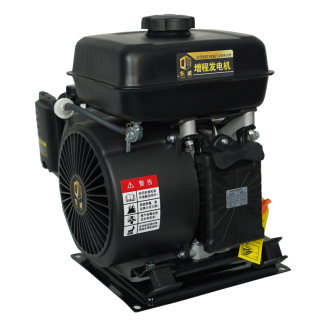
Industry Trends of Range Extender Generators in Recent Years
一、Market Trends
China passenger vehicle market: Growth has shifted from rapid expansion to structural competition. The growth rate of range-extended vehicles slows down and faces direct competition with DHT PHEVs. Only range extenders with high thermal efficiency and low fuel consumption can stay competitive.
Overseas market maintains steady growth and becomes a key growth area. Southeast Asia, the Middle East, Africa and Latin America lack sufficient charging infrastructure, leading to strong demand for portable range extenders. Europe applies strict regulations, making it difficult for conventional gasoline range extenders to obtain market access.
Application scenarios keep expanding beyond passenger cars. Demand for external modular range extenders rises for 2-wheeler & 3-wheeler EVs, campers, construction machinery, agricultural equipment, outdoor power supplies and marine equipment.
二、Technology Trends
Highly integrated design. Engine, generator and GCU electronic control unit are deeply integrated to reduce size, weight and transmission loss. High-voltage platforms are gradually adopted to improve power generation capacity.
Continuous improvement in thermal efficiency. Dedicated Atkinson-cycle range extender engines are designed solely for power generation and operate steadily in high-efficiency zones to reduce fuel consumption under battery-depleted conditions. Power conversion efficiency can exceed 95%.
NVH (noise, vibration and harshness) control becomes a core selling point. Optimized balance shafts, shock-absorbing structures and intelligent start-stop strategies reduce noise and vibration for seamless startup. This is a key indicator for buyers of portable range extenders.
Intelligent energy management via GCU. The controller dynamically adjusts generating power and start-stop logic based on battery SOC, load and ambient temperature to avoid frequent startup and balance fuel consumption, noise and emissions.
Diversified fuel exploration. Methanol and hydrogen fuel range extenders are piloted for special equipment. Gasoline range extenders remain the mainstream for civil and export markets.
三、Product & Supply Chain
Obvious market segmentation: OEM dedicated range extenders have high technical barriers. General external portable range extenders feature modular design and easy maintenance, yet domestic manufacturers face fierce price competition and squeezed profit margins.
Mature domestic supply chain reduces overall unit cost. Permanent magnet materials, electronic controls and small internal combustion engines are highly localized. Emission after-treatment systems will raise costs for compliant products.
Industry standardization and higher certification thresholds. Tightening emission regulations at home and abroad phase out low-quality simple range extenders.
四、Industry Challenges
Competition from PHEVs in passenger vehicle segment. It has extra energy conversion steps under high-speed conditions, resulting in higher fuel consumption than DHT PHEVs with direct engine drive.
Global emission regulations keep tightening, increasing compliance costs for exports.
Popularization of large-capacity batteries and fast charging weakens partial demand for range extenders in passenger cars. However, range extenders will remain a long-term necessity for off-grid outdoor scenarios.
五、Future Outlook
Passenger car range extenders will develop toward high thermal efficiency, low noise, high-voltage integration and full emission compliance. Portable external range extenders focus on lightweight, silent, modular and easy-to-maintain products, holding huge business opportunities in overseas markets with poor charging infrastructure. Gasoline range extenders act as a transitional power supplement solution, yet they will maintain stable commercial value in less developed regions and special outdoor scenarios for the next 5–10 years.